
Since 2004 the average time we spend in one window on screen has fallen from 2.5 minutes to 47 seconds. Working with AI assistants raises the pace further: you hand over a task and move to the next one the same second. Researchers call it technostress. Offices are still designed for conversation with people, although 89% of employees name focused work as the most important thing they do in the office. A lease runs for five years, so the office for 2028 is being designed today.
There is a game in which you run a clinic. Patients come in one after another, each with a patience meter above their head, and you send them to the doctor, for tests, to collect results. The game is Happy Clinic and it has more than 10 million downloads on Google Play alone. It is one of hundreds of games built on the same model; the genre is called time management games, and it was popularised by Diner Dash in 2004.
You can finish the levels, but the loop itself is designed so that in the end it always speeds up beyond what you can handle. The win is momentary, and then the queue grows again.
More than twenty years ago that was fun precisely because it was not real.
In 2004 Gloria Mark of the University of California, Irvine, began measuring how long people at a computer work in one window before switching to another: email, another file, a messenger. In 2004 it was 2.5 minutes on average. In 2012, 75 seconds. In recent years, just 47 seconds.

According to Mark, from the moment a task is interrupted to the moment her subjects actually return to it, 25.5 minutes pass on average, because other things distract them along the way.
I am writing about this because for some time now I have been playing this game every day, and only now have I realised it.
What our "standard" day looks like now
You no longer wait for the AI assistant, say ChatGPT or Claude, to finish. You hand over a task and in the same second move on to the next one, usually from a completely different project. Then you come back, check, correct and send it on, and the materials are produced without leaving a single environment, because you do not open other applications.
A report used to take several hours of sitting over it. Now you start a report and three other things happen at the same time. You do far more than a year ago, but unfortunately you do not work a minute less because of it.
I thought that since AI takes on the tedious part of the work, our heads should have it easier. Instead they have it harder.
Every return to an interrupted thread means rebuilding your own context from scratch, because the AI has its context saved and you do not.
The faster you jump between tasks, the more you have to hold in your head at once, which is why this work demands more focus today than the work we did five years ago, not less.
The phenomenon has a name. In 1984 Craig Brod called it technostress, and in 2008 Ragu-Nathan and colleagues broke it down into five components. Two of them describe our day almost literally: techno-overload, an excess of tasks and information at once, and techno-invasion, the blurring of the line between work and the rest of life.
A study from the University of Osnabrück, published at the end of 2025, looked at the phenomenon specifically in the context of generative AI. The largest group of statements from young professionals concerned neither the pace of work nor regulations, but their own heads: a sense of dependence on the tool, fear of losing their skills and weakening critical thinking. Right behind it, almost level, came positive stress, the excitement about what the tool makes possible, so both things happen in the same head at the same time.
This is clearly visible in a study by the National Bureau of Economic Research, which finds that in occupations where AI clearly complements human work, people work around 2.75 hours a week longer than where it does so only marginally. That is a correlation, not proof of causation, but the direction is telling: a technology that was supposed to shorten our day is, for now, intensifying it.
The sentence that changed my perspective
At home, when I am alone, I talk to the AI assistant and I work much faster, because by speaking I get more out of my head than I could type. The assistant asks, I answer, and in this way something emerges that I did not have in my head at the start.
In the office I do not talk, I type, because people sit next to me. I should have noticed this earlier, given that I have been designing work environments for more than a decade. The office has become the place where I work more slowly, and interestingly, not because of the technology, but because of the way it is built.
Am I alone in this?
Why you cannot talk
There are two reasons, and only one of them is obvious. The first is noise: I do not want to drown out the person sitting next to me. The second is more serious, because I work with confidential data and I will not dictate aloud anything that would allow a client to be identified.
The problem itself is not new; confidential phone calls were always made in a separate room. What is new is the scale, because it used to be an hour a day and now it will be most of the working day. Confidentiality will therefore stop being a procedural problem and become an acoustic one, that is, a challenge for designers.
The market is heading the other way
Leesman, an independent organisation that has been studying employees' experience of offices for years, shows this gap very clearly. As many as 89% of employees name individual focused work as the most important activity in the office, and it has held first place without interruption since the research began. Meanwhile 70% of corporate real estate leaders believe the office is primarily there to foster collaboration, and only 27% that it is there to support productivity. At the same time only 35% of employees are satisfied with noise levels, and 40% with quiet rooms for working alone or in pairs.

Offices today are designed for conversation with people, while work is increasingly becoming a conversation with a machine.
The market is solving last decade's problem very well. The trouble is only that it is no longer the problem.
In one office today sit, side by side, people who have not yet used AI and people who have already been through the whole curve of change and are getting the best out of the technology.
How do you reconcile those needs?
The real design brief
I understood the most when I started watching how others work with AI.
I think out loud and I need to get a lot out before I reach the point, so conversation is the ideal form of work for me: I go in with nothing and come out with a finished concept.
But there are people who work exactly the other way round: they think for a long time, in silence, and then say one precise sentence. For such a person an assistant that keeps asking questions and offering further variants is more of an obstacle than a help.
And here I come to the thing that worries me most. Companies have just started rolling out, at scale, tools designed for one type of work, and a person who thinks differently does not simply get a worse tool. They get a signal that they are not keeping up.
I work on neurodiversity in the workplace, and for years in design it came down to one conclusion - give people choice, for example in the form of different spaces in the office suited to different needs.
Today that is no longer enough, because if the way you think determines what your work with a tool you use all day looks like, then variety of space stops being a convenience and becomes a condition of someone being able to show what they are worth at all.
What this changes in managing people
For now, phew, you can still see who is thinking. To get a sensible answer out of AI you have to know your field, and a person who does not gets a worse result, and it still shows in what they produce.
In the future that knowledge threshold will not disappear, but it will keep falling until the difference stops being visible at first glance. Then we will start judging something else: above all synthesis, the ability to tell what really has value from what there is simply a lot of and what only makes informational noise, and then the ability to translate it into a form another person can understand.
In the end what will probably remain is commitment, and although I know it sounds strange, in my view it will become more important than knowledge. Knowledge will be available to anyone who knows how to ask; the will to do something properly rather than any old how will not.
Back to the game
We like time management games because they give us adrenaline: the queue, the timer, I made it, hooray! Working with AI works on a similar principle, and most strongly on those who grew up on such games. Except that in those games the pace always ends up rising beyond what you can handle, because that is how they are designed.
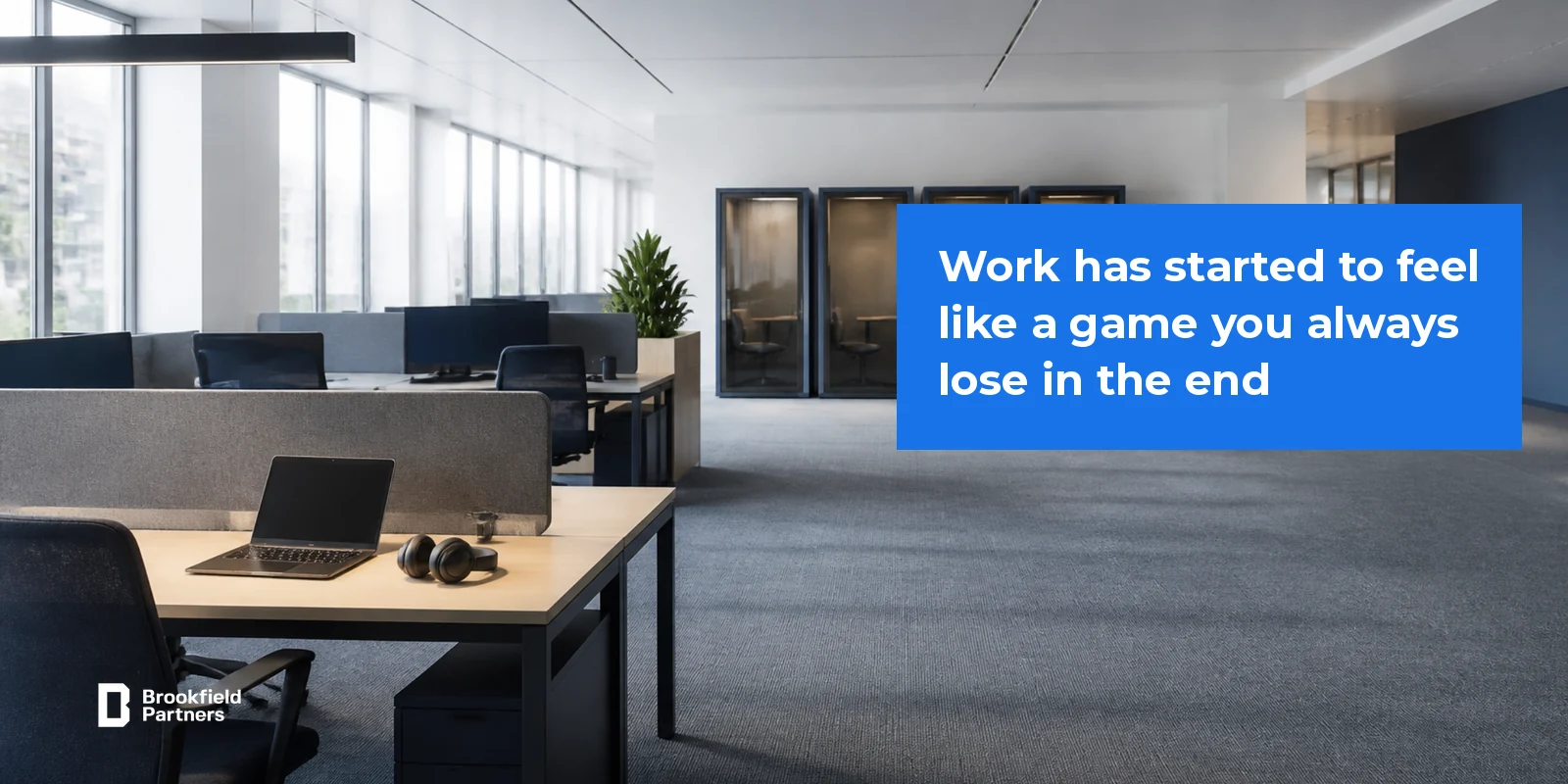
Work has started to feel like a game you always lose in the end. I wrote that sentence fully aware that I play this game myself and that I enjoy it.
Technostress researchers have a separate word for this, techno-eustress, which describes the same mechanism, only experienced as pleasure. The fact that something brings joy and excitement does not mean, however, that it is not wearing us down.
I am not ending this piece with advice on how to be more efficient, but with a question: at what point does it stop being work and become pace for its own sake? The answer requires self-awareness and knowledge of your own head and your own limits, and that sounds like a completely different discipline from designing offices.
Some of us will, over the coming years, work by voice, with more focus than before, each at our own rhythm and each differently, and the office in which we do it will have to look different from anything we design today.
A lease is signed for five years, sometimes longer, so the office we will move into in 2028 is being designed today, on the basis of how we work today. And we have only been working this way for a dozen or so months...
Sources
- Mark, G. (2023). Attention Span: A Groundbreaking Way to Restore Balance, Happiness and Productivity.
- Capuano, C. (2023, 11 May). Can't pay attention? You're not alone [interview with Gloria Mark]. University of California / UC Irvine.
- Brod, C. (1984). Technostress: The Human Cost of the Computer Revolution. Addison-Wesley.
- Ragu-Nathan, T. S., Tarafdar, M., Ragu-Nathan, B. S., Tu, Q. (2008). The Consequences of Technostress for End Users in Organizations: Conceptual Development and Empirical Validation.
- Högemann, M., Hein, L., Britsche, J.-O., Thomas, O. (2025). Technostress and generative AI in the workplace: a qualitative analysis of young professionals. Frontiers in Artificial Intelligence. University of Osnabrück / DFKI.
- Jiang, W., Park, J., Xiao, R. J., Zhang, S. (2025). AI and the Extended Workday: Productivity, Contracting Efficiency, and Distribution of Rents. NBER Working Paper No. 33536.
- Leesman (2025, April). The workplace why.
- Yekani, S. / Leesman (2026, March). Noisy spaces, quiet consequences.
- Tarafdar, M., Cooper, C. L., Stich, J.-F. (2019). The technostress trifecta - techno eustress, techno distress and design: Theoretical directions and an agenda for research.