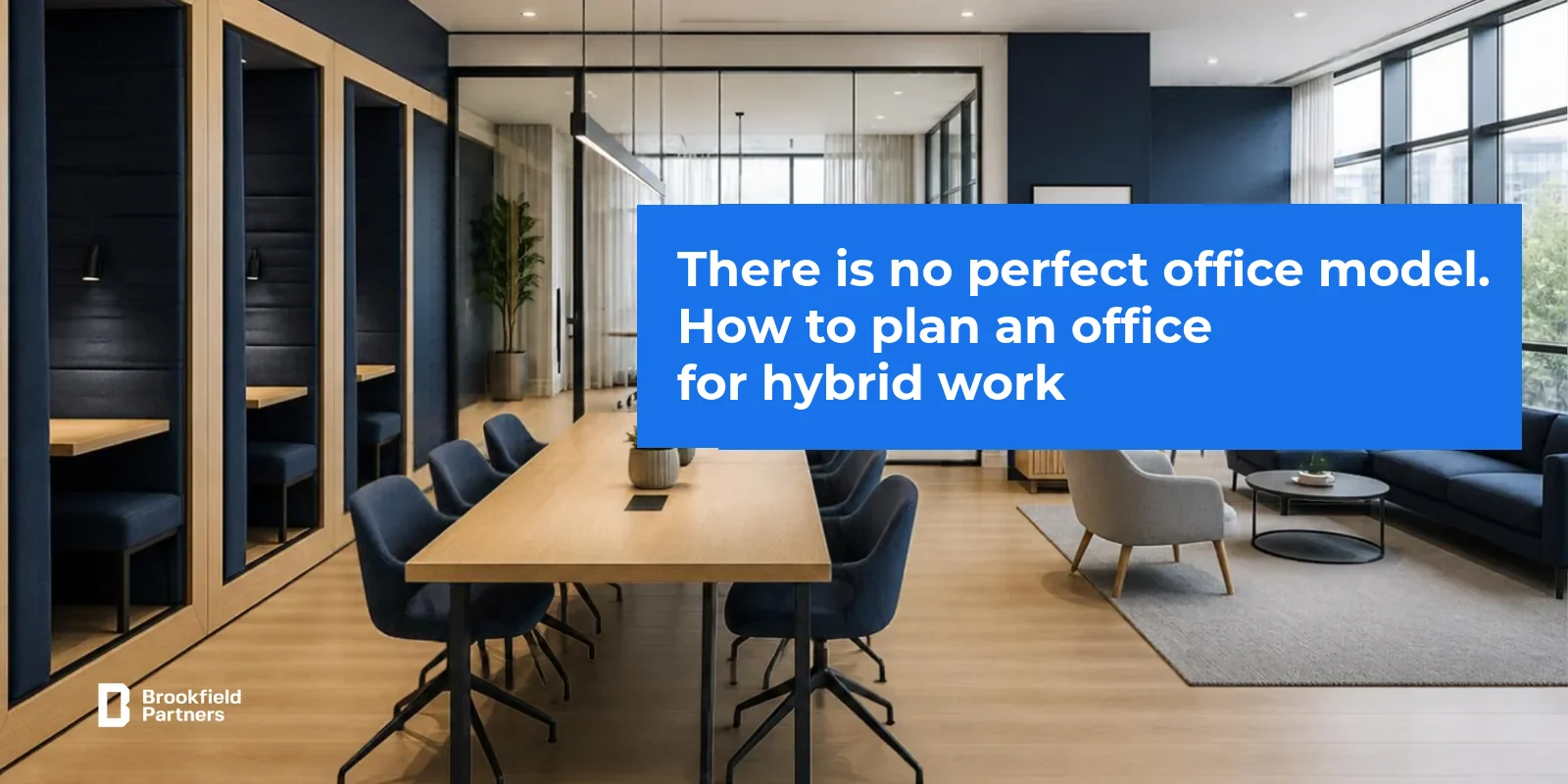

There is no single perfect model for the office or for hybrid work. What employees want depends on the type of work they do, their stage of life, their industry, their home situation and their commute, rather than primarily on their age. That is why the workplace strategy should be set before any design decisions, based on data about how people actually work. Neither a set number of office days nor a new fit-out will create collaboration on its own, and after the move the office needs to be measured and improved on an ongoing basis.
Companies too often plan their office on the basis of assumptions. That young people want to come into the office. That people come in mainly to collaborate. That open-plan space supports communication, and more days in the office mean a stronger culture. And that all employees have broadly similar needs.
Our own observations and conversations with clients point to something different. Preferences vary considerably by age, type of work, industry, home situation and commuting time. Below I have set out what most often works in practice when a company is planning a new office or changing its current one.
Start with how people work, not with the furniture
A project should not begin with choosing furniture, an interior style or a desk-to-employee ratio. The first step is to establish how people actually work:
- what tasks they do, and when they need to collaborate and when they need to concentrate,
- why they come into the office and what makes it harder for them to use it,
- how teams are structured and how they are managed.
Only on that basis can you define the role of the office and the amount of space it needs. The workplace strategy should be in place before any design decisions are taken. For a tenant, this has a very concrete dimension too: it determines how many square metres to lease and how much flexibility to build into the lease.
An organisation is several groups, not one average employee
Within a single company, people who need quiet for focused work sit alongside project teams that grind to a halt without intensive collaboration. Some live close to the office, others commute for more than an hour. A young employee renting a room often has poor conditions for working from home, while an experienced specialist has a separate study. Some people need frequent contact with others, while some prefer to work independently.
That is why an office is designed for specific groups and ways of working, not for an abstract “average employee”.
Age explains less than you might think
Beware of generational stereotypes. You cannot assume from the outset that younger people want to be in the office for most of the week, that older people prefer to work from home, or that one generation needs collaboration while another needs focus.
More often, the deciding factors are the nature of the work, stage of life, place of residence, family situation and the conditions for working from home. The differences stem not only from age, but also from role, industry and how people get to work.
The commute weighs most in an employee's decision
Employees weigh the value of a day in the office against the length and cost of the commute. The longer the journey, the more insistently the question comes back: what will I get in the office that I do not have at home?
If, after an hour in traffic, they spend the day on online meetings or do not meet the people they wanted to work with, they start to see coming into the office as a waste of time. The office has to offer real value, not just a place to open a laptop. This is one of the reasons why a location should be chosen with a map of the team's commutes to hand.
Presence in the office does not mean collaboration
Requiring people to come into the office a set number of days does not guarantee collaboration, knowledge sharing, team cohesion or a stronger culture. People can sit in the same building and still work separately, joining meetings over Teams.
Coordinating attendance matters more than the number of days. Teams should agree when, and why, they meet in person.
An office is a choice of settings, not one large open-plan space
One large open-plan area cannot meet every need. An office that works well offers choice: quiet spaces for concentration, rooms for online calls, spots for short meetings, project rooms, space for teamwork and for an ordinary chat over coffee.
It is not only about an attractive interior. It is about removing the everyday problems: noise, lack of privacy, hunting for a free desk and no meeting room when one is needed.
Visibility is not productivity
Presence in the office is easy to see, but it does not necessarily mean higher productivity. Different tasks are best done in different places. Work that requires focus is often better done at home or in a quiet zone. Building relationships and solving ill-defined problems more often succeed together. Routine update meetings work well online, while workshops, onboarding and creative work usually go better in person.
A mature hybrid model matches the setting to the type of work, rather than applying one rule to everyone.
New space will not change behaviour
A move will not solve organisational problems unless there is also a change in how leaders behave, the rules of collaboration, the way meetings are run, expectations around availability and the communication about what the office is for. Workplace is a combination of space, technology, culture and management style. A change of address on its own deals with only the first of these.
A benchmark is a point of reference, not a decision
A ratio that worked for one company will not necessarily work for another. This applies to the number of office days, the number of desks per employee, the share of meeting rooms, the proportion of collaborative space and the target utilisation of the space. A benchmark helps you ask the right questions, but the answer has to come from data about your specific organisation.
The office needs measuring after the move, too
Workplace is a process, not a one-off project. After implementation, it is worth tracking:
- actual space utilisation and the differences between days of the week,
- which zones are overloaded and which are in short supply, particularly spaces for focus and for meetings,
- employee satisfaction and the impact of the changes on the way people work.
The office has to be adjusted regularly, because the organisation, headcount and people's behaviour all change. How to measure satisfaction with the office after a move was discussed in our podcast by Agnieszka Wąsowska.
A good office is not the product of trends or of the board's assumptions. It comes from understanding how differently people actually do their work.