
An office lease taken by a Polish public body, agency or state-owned company is excluded from the Public Procurement Law, but the tenant adviser's service is not. If the body pays the adviser itself and the contract is worth more than PLN 170,000 net, it has to run a procurement procedure. If the landlord pays the adviser, the contract costs the public body nothing and is not a public contract. Either way, the market search and the market level of the rent have to be documented, because that is what the Supreme Audit Office (NIK) and regional audit chambers check.
A Polish public body can lease an office without a tender, but not without proof that it chose sensibly. The Public Procurement Law (Pzp) excludes leases from its procedures, so the choice of building rests with the head of the institution or the company's management board. The spending still has to be purposeful and economical, and the decision can later be audited by NIK. Below I explain when choosing a tenant adviser falls under the Pzp, who pays the adviser and which documents should remain once the process is over.
The lease is excluded from the Pzp, advice on the lease is not
Art. 11(1)(6) of the Pzp excludes contracts for the acquisition of ownership of, or other rights to, existing buildings or real estate. Commentaries on the law apply this exclusion expressly to leases as well. The reasoning is practical: a public body looks for a specific location, so a tender for “any office” would make no sense.
The exclusion covers the lease itself, though. Advice on the lease, a space needs analysis or a fit-out design are separate services, and services fall under the law in the usual way. Directive 2014/24/EU, the source of the exclusion, speaks of contracts for the acquisition or rental of immovable property, and advice is not rental.
The law applies to bodies that are contracting authorities within its meaning: public finance sector units, but also many companies owned by the State Treasury or local governments if they meet needs in the general interest. Whether a given company is a contracting authority is for its legal department to decide. The rest of this article assumes it is.
Who pays the adviser and what that means for the procedure
On the office market the tenant's adviser is usually paid by the landlord of the building where the lease is signed. The fee equals two to three months' rent on a lease of at least five years. We describe the model in detail in Who really pays the office leasing advisor? For a public body this leaves two routes.
The first route: the body pays the adviser itself. That is an ordinary services contract. Since 1 January 2026 the Pzp applies from PLN 170,000 net, up from PLN 130,000. Below the threshold, the choice of adviser follows the body's internal procurement rules. Above it, the national procedure applies, and from PLN 603,400 for central government authorities and PLN 930,960 for other classic contracting authorities the EU procedure applies. The EU thresholds for 2026-2027 are set out in the notice of the President of the Public Procurement Office (UZP) of 8 December 2025.
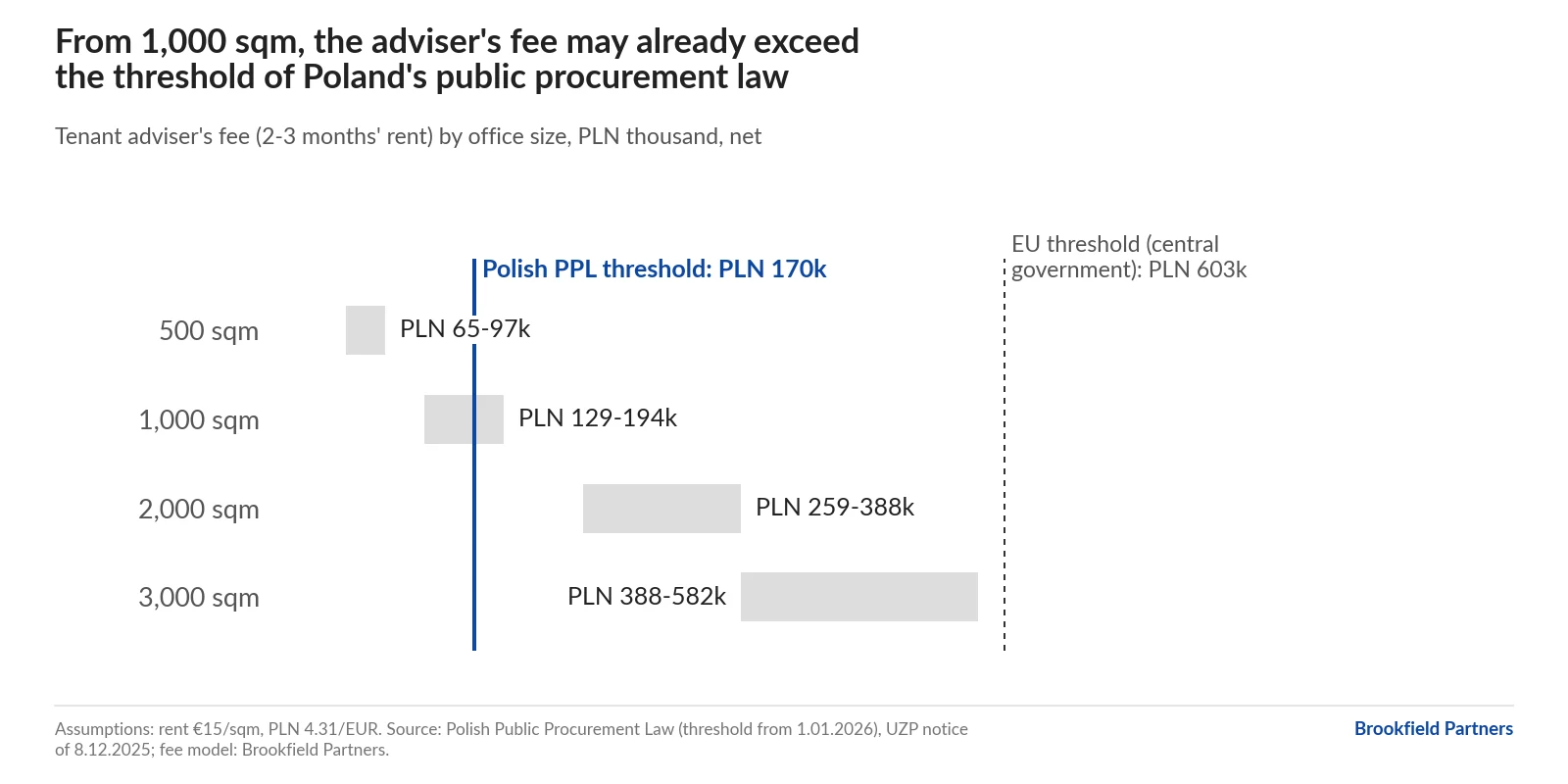
The chart below shows how close a typical fee is to the threshold. For a 1,000 sqm office at €15/sqm, two to three months' rent comes to €30,000-45,000, or roughly PLN 129,000-194,000 at PLN 4.31 to the euro. A 2,000 sqm office is clearly above the national threshold. The contract value is estimated for the whole term of the adviser's engagement, so additional services such as fit-out supervision have to be included.
The second route: the landlord pays the adviser. The public body's contract with the adviser is then unpaid. The Pzp defines a public contract as a contract for consideration (art. 7(32)), so such a contract is not a public contract. The same reasoning appears in an opinion on choosing an insurance broker paid by the insurer, published by the UZP in 2010. It concerns the previous law, but the consideration requirement has not changed. It is worth confirming this with the body's legal counsel before signing.
An unpaid contract still calls for a transparent choice
In our view a public body should choose its adviser competitively even when it pays nothing. A request to three or four firms with criteria set in advance is enough: scope of services, the team, experience with similar tenants and a conflict-of-interest statement. The adviser's fee is built into the rent the public body will pay anyway, so a “free” adviser is not neutral for the budget.
The most important criterion is the absence of a conflict of interest. An agency that also leases space on behalf of landlords may recommend its own client's building. In the public sector that risk weighs more, because an audit will ask why this building was chosen and not another. The contract with the adviser should include a statement that it does not represent any landlord on the shortlist and an obligation to disclose the fee it will receive from the landlord.
How to document that the rent is at market level
The Pzp exclusion does not lift the rules on spending public money. Public finance sector units must spend funds purposefully and economically, following the principle of obtaining the best results from given outlays (art. 44(3) of the Public Finance Act). Companies owned by the State Treasury or local governments answer to their supervisory board and owner, and their articles often require corporate approval for contracts above a set value. NIK can audit both.
What such an audit looks like is shown by NIK's August 2019 report on the new headquarters of the Polish Financial Supervision Authority (KNF). NIK found the lease of the building at ul. Piękna 20 in Warsaw, 14,100 sqm, to be purposeless and uneconomical. The rent was to be about PLN 15.5 million a year plus about PLN 4 million in service charges, while the previous arrangement had cost about PLN 7 million a year in total.
When the lease process is over, the file should contain:
- a needs analysis prepared before talking to landlords: headcount, ways of working, required area, technical and location requirements;
- a comparison of staying and relocating by total occupancy cost over the whole lease term, including rent indexation, service charges, rent-free periods, the fit-out budget and moving costs;
- a list of buildings that meet the requirements and the reasons for rejecting those that dropped out;
- offer evaluation criteria fixed before the offers were opened, and a record of the comparison;
- successive versions of the offers from the negotiations, showing what was improved;
- a comparison of rents with an independent source of market data as at the decision date.
Many Polish public bodies publish a notice in their Public Information Bulletin (BIP) that they are looking for space. It leaves a useful transparency trail, but it is no substitute for a market search: it will be answered by landlords who notice it, not by everyone who has suitable space. The search should cover the whole market in the location. For comparison, OfficeList Pulse monitors 612 modern class A and B office buildings in Warsaw and 96 in Gdańsk.
Renewing without negotiation costs more today than a year ago
The most common scenario in the public sector is renewing the lease in the current building, because a move requires approvals, budget and time. The landlord knows this. Meanwhile the market is tightening: according to OfficeList Pulse, Warsaw vacancy fell to 7.52% at the end of Q3 2026, the lowest in the series that began in 2023, and in Gdańsk the average asking rent rose by 11.2% over the year. The details are in our reports Warsaw office market - Q3 2026 and Gdańsk office market - Q3 2026. Without a costed alternative, a public body negotiates from a position where the landlord sets the terms.
Renegotiation is best started 18 to 24 months before the lease ends. In the public sector closer to 24 months, because corporate approvals, budget planning and possibly a procedure to choose the adviser come on top of the usual timetable. A body whose lease ends in 2028 should therefore decide this year whether it will pay the adviser itself, plan the funds in its 2027 budget and start talking to landlords in the first half of 2027.
This article describes Polish law as of October 2026 and is not legal advice. Its application to a specific body should be confirmed with that body's legal counsel.