

In 2026 Warsaw and the regional cities are two different markets. In Warsaw, vacancy has fallen to 8.03% and negotiations centre mainly on the incentive package; in Kraków (18.68%) and Wrocław (20.00%) the rent itself can still be brought down. We start talks with clients 12-24 months before the lease expires, with 2-3 alternative offers in hand, and we compare offers on effective rent. On a 5-year lease, effective rent is typically 15-25% below the asking rent.
For most companies, the office lease is the second-largest fixed cost after payroll. It is signed once every 5-7 years, and across the table sits someone who concludes such deals every week and knows every clause the tenant will forget to ask about.
We update this guide every year, drawing on OfficeList Pulse data and our own negotiations. It sets out what we check for clients in 2026 before they sign or renew an office lease: market conditions, effective rent, indexation, service charges, lease flexibility and security.
The office market in 2026: Warsaw and the regions are two different markets
Before you open talks, establish who currently holds the stronger hand. In 2026 that depends above all on the city and, in Warsaw, on the district as well.
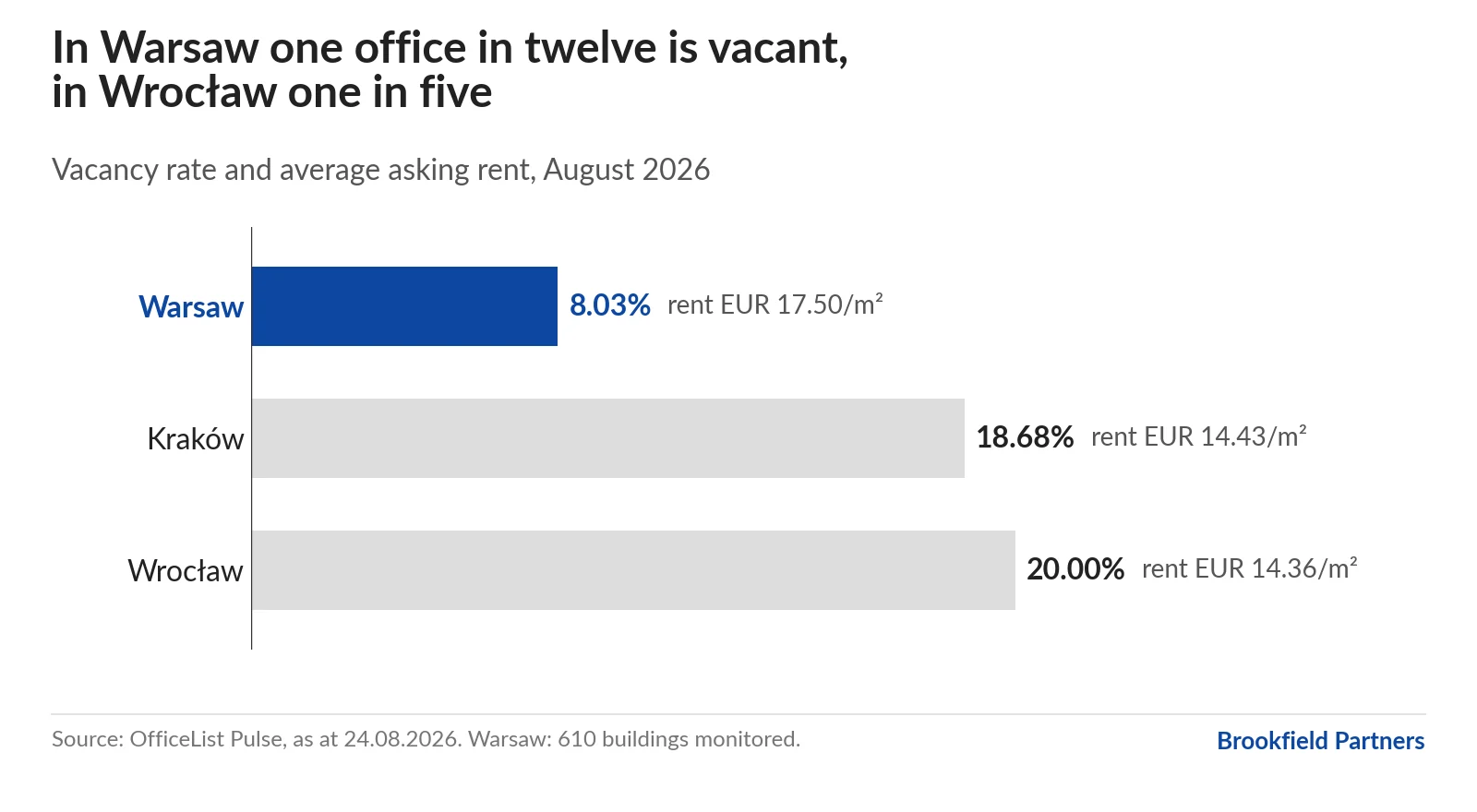
In Warsaw, the balance of power is shifting towards landlords. According to OfficeList Pulse (as at 24 August 2026, 610 buildings monitored), the vacancy rate has fallen to 8.03%. A year earlier it was above 10%, and over the same period available space shrank by more than 200,000 m² to 536,000 m². The average asking rent is EUR 17.50/m²/month (compared with EUR 16.01 at the end of 2024), and EUR 26-30 in the best buildings in the city centre. Around 128,000 m² is under construction, less than 2% of total stock, so there will be virtually no new supply in the centre before 2027-2028.
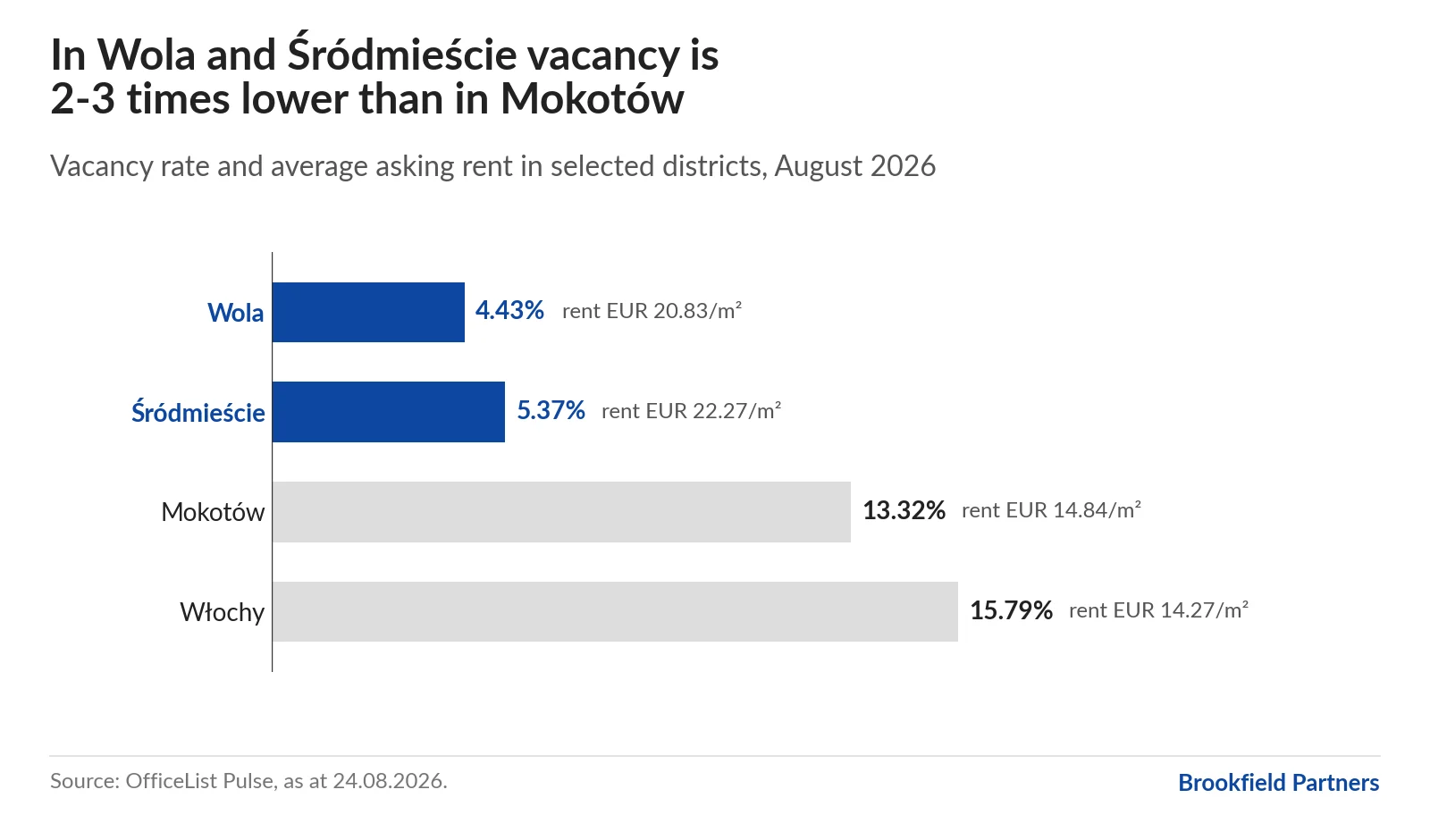
In the regional cities, tenants still set the terms. In Wrocław, vacancy remains at 20.00% (after peaking at 20.86% in Q2 2026), with an average asking rent of EUR 14.36/m²/month, and the differences between districts are large: 27.12% of space is vacant in the Centrum district, while Krzyki (8.62%) and Psie Pole (4.91%) are almost fully let. In Kraków, vacancy has been falling steadily since the end of 2024 but still stands at 18.68% (average EUR 14.43), ranging from 7.90% in Śródmieście to 35.25% in the north-west of the city. In these conditions, owners of older and non-central buildings are making substantial concessions to retain or attract tenants.
Our negotiations point to a simple split. In central Warsaw, talks today focus mainly on the incentive package and lease flexibility, because landlords barely move on the headline rent. In the regions and in non-central buildings, the rent itself can be negotiated down. Subleases are a separate pool: more than 73,000 m² across 101 offices in Warsaw, and roughly another 38,000 m² in Wrocław and Kraków combined, usually 20-40% cheaper than a direct lease.
When to start negotiating: 12-24 months before the lease expires
The most common mistake we see is about timing, not clauses: tenants start too late. A company that opens talks 3-4 months before its lease ends no longer has an alternative, as there is not enough time to find, negotiate and fit out new space. The landlord knows this and prices the renewal offer accordingly.
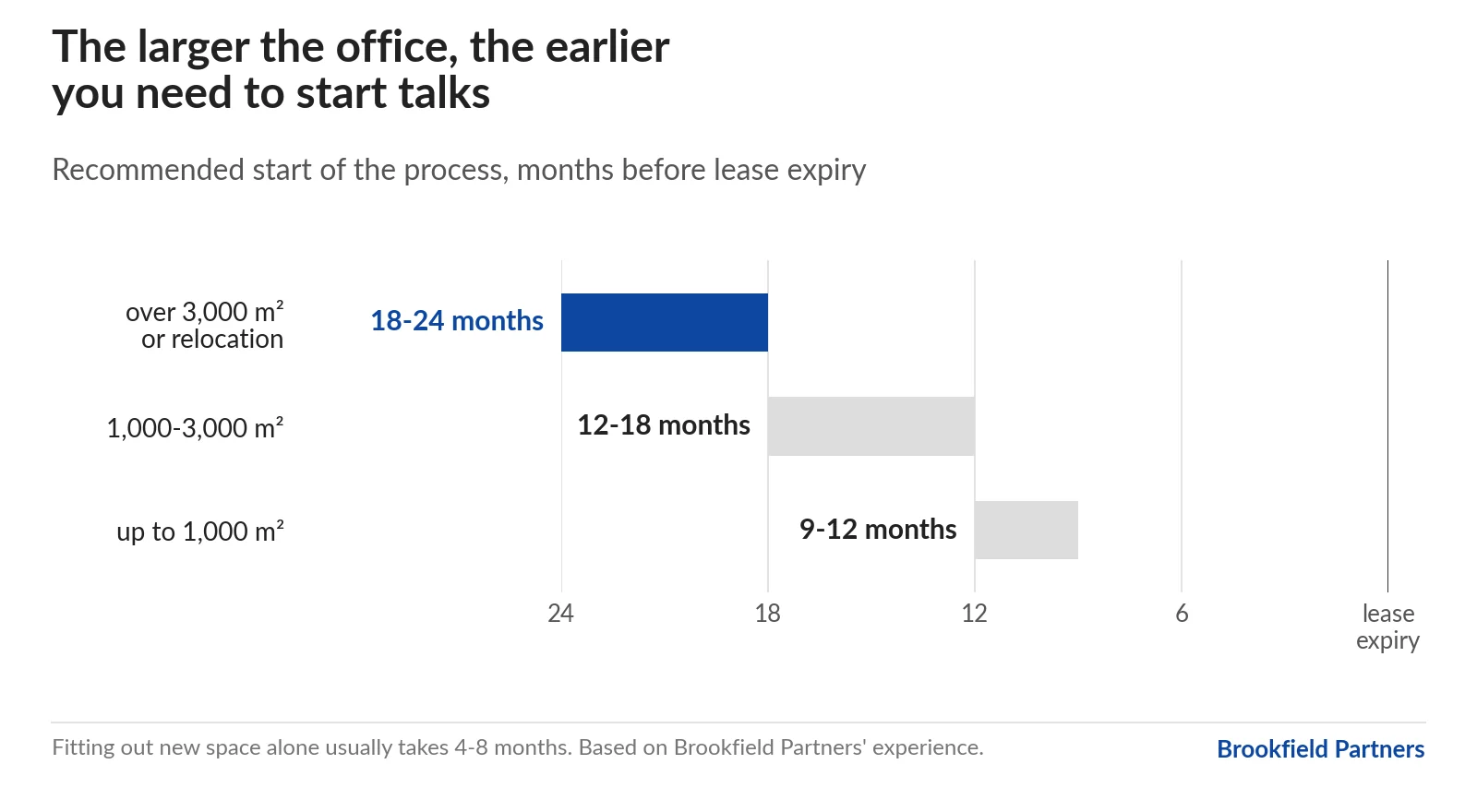
Around half of leasing volume in Poland today consists of renegotiations, in which the tenant stays put. That is sensible in itself, but a renegotiation only delivers good terms if the landlord believes the tenant could genuinely move out. That is why even a company that wants to stay should collect 2-3 binding offers from other buildings in parallel. Without them, nobody knows what the space is worth today, and the landlord will quickly notice that the tenant has nowhere to go. We explain this dynamic in more detail in our article “When to start renegotiating your lease”.
Headline rent versus effective rent
The rent written into the lease (the headline rent) is almost always higher in Poland than the actual average cost of occupancy. The difference comes from incentives. Landlords prefer granting them to cutting the rent, because the headline rent drives the building's valuation:
- Rent-free periods, which in market practice range from a few months to well over a year on a 5-7-year lease. In regions with high vacancy, packages are often noticeably more generous than in central Warsaw.
- A fit-out contribution, i.e. the landlord's share of the cost of fitting out the space, usually expressed in EUR/m². With fit-out costs rising, this is often the most valuable part of the package. Also negotiate when it is paid out and what happens to any unused portion.
- Other incentives: covering relocation costs, a temporary waiver of service charges, parking spaces included in the rent, a contribution towards the security deposit.
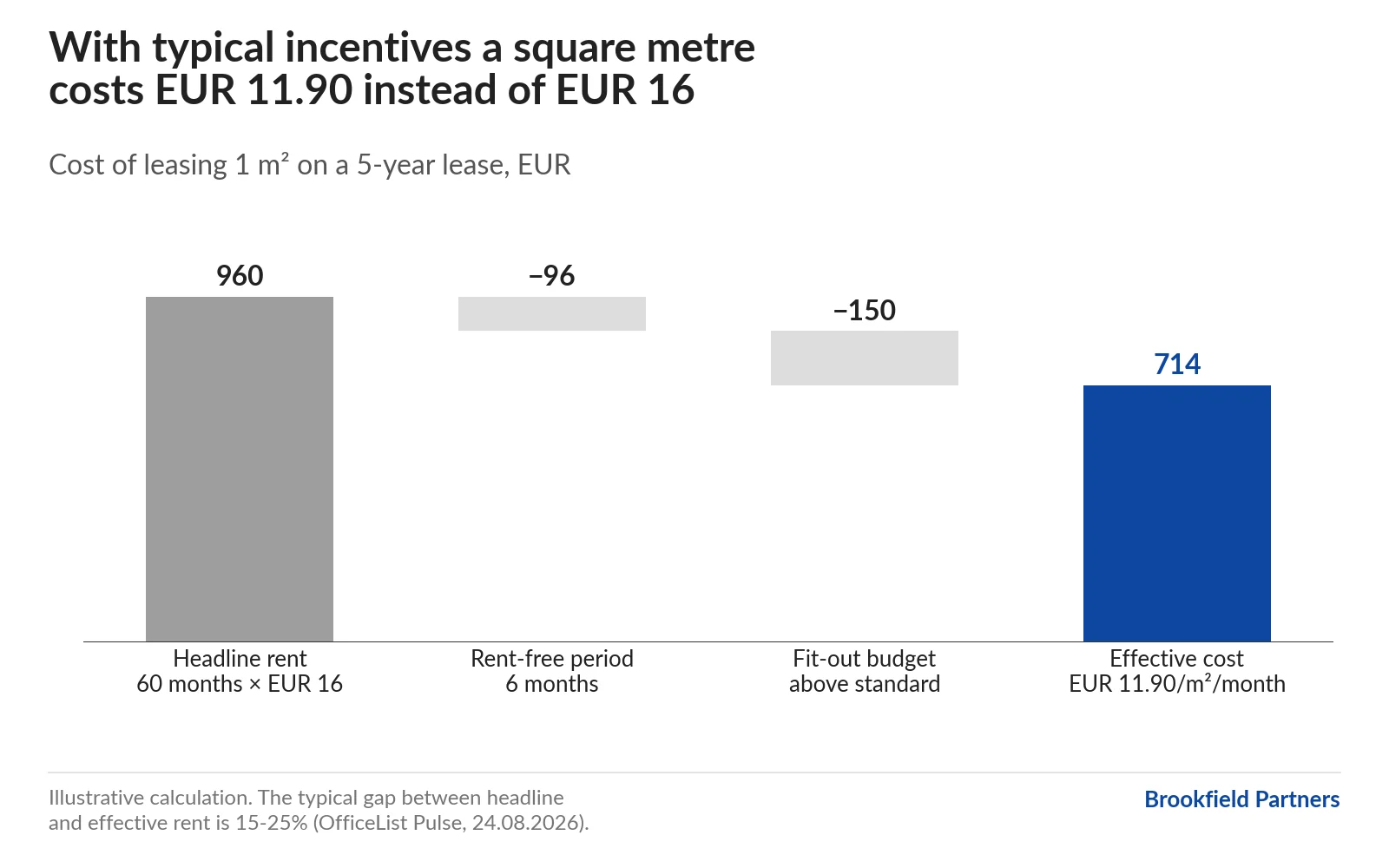
Anyone who compares offers on headline rent alone usually makes the wrong choice. OfficeList Pulse data show that on 5-year leases the real cost of occupancy is typically 15-25% below asking rents, depending on location and the building's vacancy level.
Rent indexation: what can be negotiated
In Polish office leases, rent is almost always denominated in euros and indexed once a year to the eurozone HICP (or, for rents in zloty, to the Polish CPI published by GUS, Statistics Poland). Indexation works in one direction only: standard clauses provide for rent increases but not for decreases in the event of deflation. After years of high inflation, tenants who signed leases a few years ago often pay more today than new tenants in the same building. We look at this paradox in more depth in “Indexation vs. the market”.
The lease can include:
- an indexation cap, i.e. an upper limit on the annual increase (e.g. 3-4%), which is particularly valuable on longer leases;
- a deferred first indexation, so that it does not kick in just a few months after signing;
- a symmetry clause, providing that the rent falls accordingly if the index is negative (hard to obtain, but worth trying for);
- a precise definition of the index: which index, from which publication date, and what happens if it ceases to be published.
Service charges: what to put in the lease
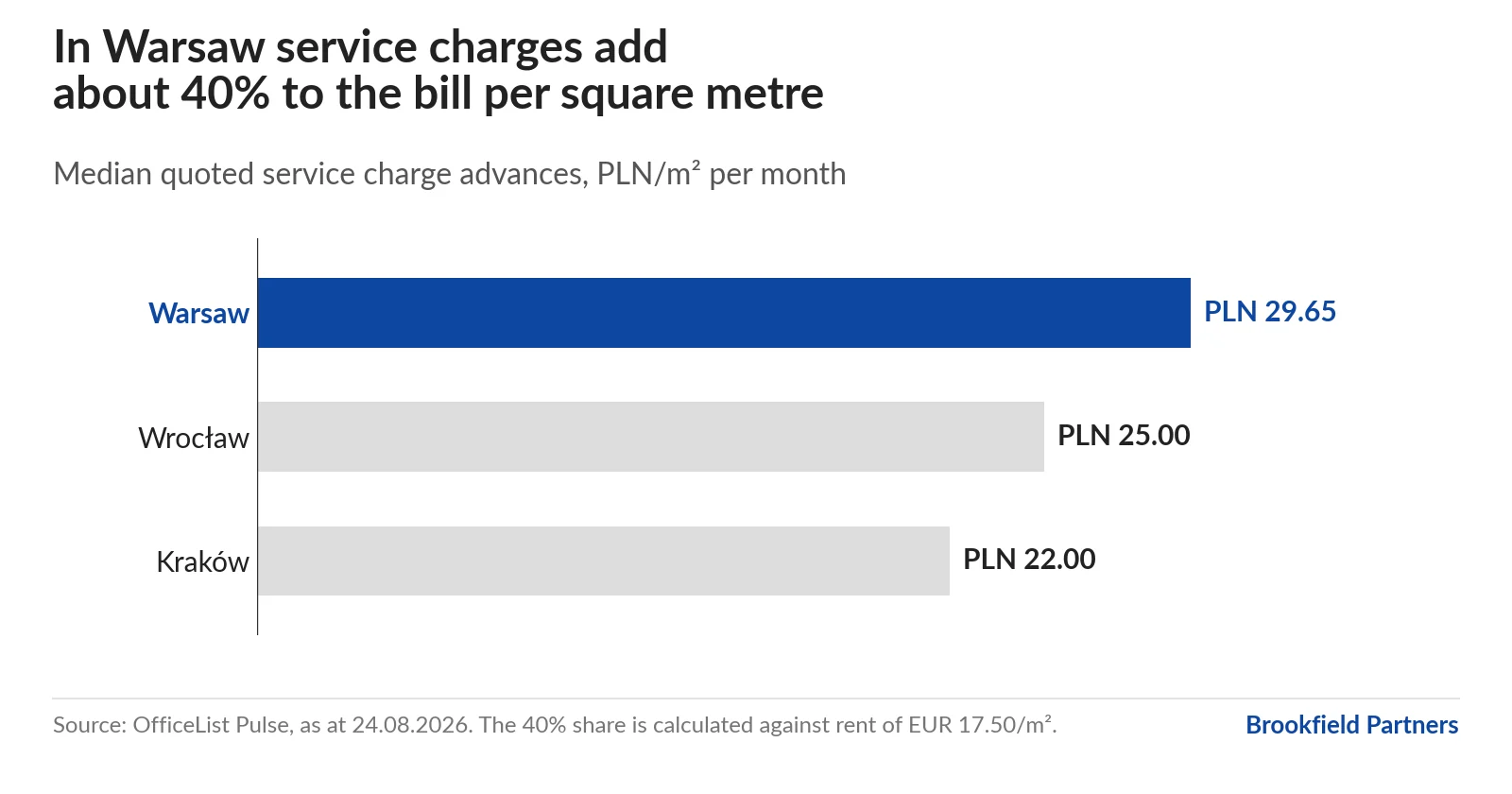
On top of the rent come service charges, i.e. the building's running costs apportioned among tenants. According to OfficeList Pulse, the median quoted service charge advance is PLN 29.65/m²/month in Warsaw, PLN 25.00 in Wrocław and PLN 22.00 in Kraków.
At these levels, we negotiate service charges with the landlord just as hard as the rent. We have gathered detailed figures for the three cities in our article on how much office service charges cost, and the items you should not be paying for in our exclusions list. In the lease, we check above all:
- a closed list of costs: a precise list of what the charges cover, plus exclusions (e.g. capital expenditure on the building, the cost of letting vacant space, management fees above the market standard);
- an open-book principle, i.e. the right to inspect actual costs and an annual reconciliation of service charge advances, together with audit rights;
- a service charge cap, i.e. a limit on the annual increase in costs within the landlord's control;
- the add-on factor for common areas: check which standard the space is measured under and how large the common-area load is (usually 2-8%); you pay for every square metre, including the shared ones.
Lease term and flexibility: break options, renewals, expansion
The market standard in Class A buildings remains a fixed-term lease of 5 years (7 years for large premises or an expensive fit-out). Under Polish law, a fixed-term lease generally cannot be terminated early. It can only be ended before expiry in the cases set out in the lease itself (Article 673 § 3 of the Kodeks cywilny, the Polish Civil Code), so an exit right you do not write in before signing will not appear later.
With today's uncertainty about working models and headcount, flexibility can matter more than the last EUR 0.50 off the rent:
- A break option, i.e. the right to terminate the lease early (e.g. after 3 years of a 5-year lease), usually subject to an appropriate notice period and partial repayment of incentives. Even a conditional break significantly strengthens the tenant's hand in the next renegotiation.
- A renewal option: the tenant's unilateral right to extend the lease on terms set in advance (ideally at market rates with a defined procedure for determining them, rather than “to be agreed”).
- Expansion rights and a right of first refusal: priority to lease adjacent space when it becomes available. Given the low supply in central Warsaw, this clause is worth a great deal.
- A contraction right: the ability to give back part of the space at a specified point in the lease (less common, but achievable where the market favours tenants).
- Subletting and assignment: consent to sublet at least within the corporate group, and to assign the lease in the event of a corporate restructuring. Standard draft leases require the landlord's consent every time, and this is worth softening to “consent not to be unreasonably withheld”.
Lease security: bank guarantees, deposits and the Article 777 declaration
The Polish market standard calls for security equal to 3-6 months of rent and service charges (gross), in the form of:
- a bank guarantee, which institutional landlords most often expect. The bank charges a fee for it and usually ties up part of your credit line;
- a cash deposit, which freezes cash. Negotiate interest on it and precise terms for its return;
- a declaration of voluntary submission to enforcement (Article 777 of the k.p.c., the Polish Code of Civil Procedure), i.e. a notarial deed that allows enforcement without court proceedings. Landlords treat it as standard, and tenants should make sure the amount and scope are strictly limited (e.g. to unpaid rent and vacating the premises) and that the declaration expires with the lease.
Negotiable points include the amount of security (a financially sound tenant can secure 3 months instead of 6), its gradual reduction over the lease term and the deadline for returning it after the lease ends.
Condition of the space, fit-out and exit obligations
Disputes over the technical condition of the space most often arise at the start and the end of the lease. The lease must include:
- a precise definition of the handover standard: exactly what the “shell and core” standard or the existing fit-out comprises (a technical schedule, not generalities);
- a timetable and penalties: the handover date, contractual penalties for delay and a right to withdraw in the event of a serious delay;
- a split of responsibility for the works: who designs, who builds, who obtains permits (a “landlord fit-out” versus a “cash contribution” model);
- the reinstatement clause. Standard draft leases require the tenant to restore the space to its original condition at its own expense. At the end of the lease that can mean hundreds of thousands of zloty, so negotiate to have it deleted or limited to removing non-standard installations.
Environmental provisions are increasingly on the table too. Because of ESG reporting and EU rules on the energy performance of buildings, tenants need utility consumption data from the landlord. BREEAM and LEED certification affects running costs and whether the office will still meet the tenant's corporate requirements in 5 years' time. Negotiate “green clauses” (data sharing, upgrade standards, utility billing) now, especially in older buildings.
Renegotiate or relocate? Run the numbers on both options in full
A tenant that stays put saves on the move and avoids disrupting the team. The landlord knows the value of that convenience and usually prices it into the renewal offer. Relocation, on the other hand, gives access to the full incentive packages offered to new tenants and a chance to right-size the office to actual needs (with hybrid working, many companies occupy 20-30% more space than they use). We make the decision with our clients based on the numbers: effective rent in both scenarios over the full term, one-off costs and the value of flexibility. We describe both routes in detail on our renegotiation and relocation pages.
The mistakes tenants repeat most often
- Starting too late. Without a genuine alternative, the tenant has no leverage.
- Comparing headline rents instead of effective rent over the full lease term.
- Ignoring service charges and the add-on factor when comparing offers.
- Accepting the first draft lease, even though the landlord's template is only a starting point for discussion.
- No scenarios for headcount growth or reduction. A lease without expansion, contraction or subletting options locks the company in for years.
- Accepting an unlimited Article 777 declaration and excessive security without discussion.
- Negotiating alone against a landlord-side team that does this every day.
Checklist before signing an office lease in 2026
- Start the process 12-24 months before the current lease expires
- At least 2-3 genuine alternative offers as a benchmark
- Offers compared on effective rent (rent, rent-free periods, fit-out, service charges)
- Indexation: index, first indexation date, cap
- Service charges: closed list of costs, exclusions, open book, annual reconciliation
- Verification of floor area and the add-on factor
- Break option, renewal option, expansion rights and subletting
- Security: form, amount, reduction over time, return terms
- Handover standard and penalties for delay
- Reinstatement clause limited or deleted
- ESG provisions: utility data, certification, green clauses
- Lease reviewed by a lawyer and a market advisor before signing
Where to start if your lease expires within two years
Start with two things. Calculate the effective rent on your current lease, including the indexation still to come before it expires, and request offers from two or three buildings that could realistically accommodate you. In Warsaw, with vacancy at 8%, the best space in the centre can disappear within a single round of talks, so speed matters. In Kraków and Wrocław you have more time and a stronger position too, and there is no reason not to negotiate the rent itself.
Market data: OfficeList Pulse (Brookfield Partners' office market analytics, live data; as at 24 August 2026) and reports: Warsaw (June 2026), Wrocław (July 2026), Kraków (August 2026). This article is for information only and does not constitute legal advice. Last updated: September 2026.

Negotiating a lease? Get in touch
I will reply personally and tell you where to focus your negotiations in your situation. No obligation.