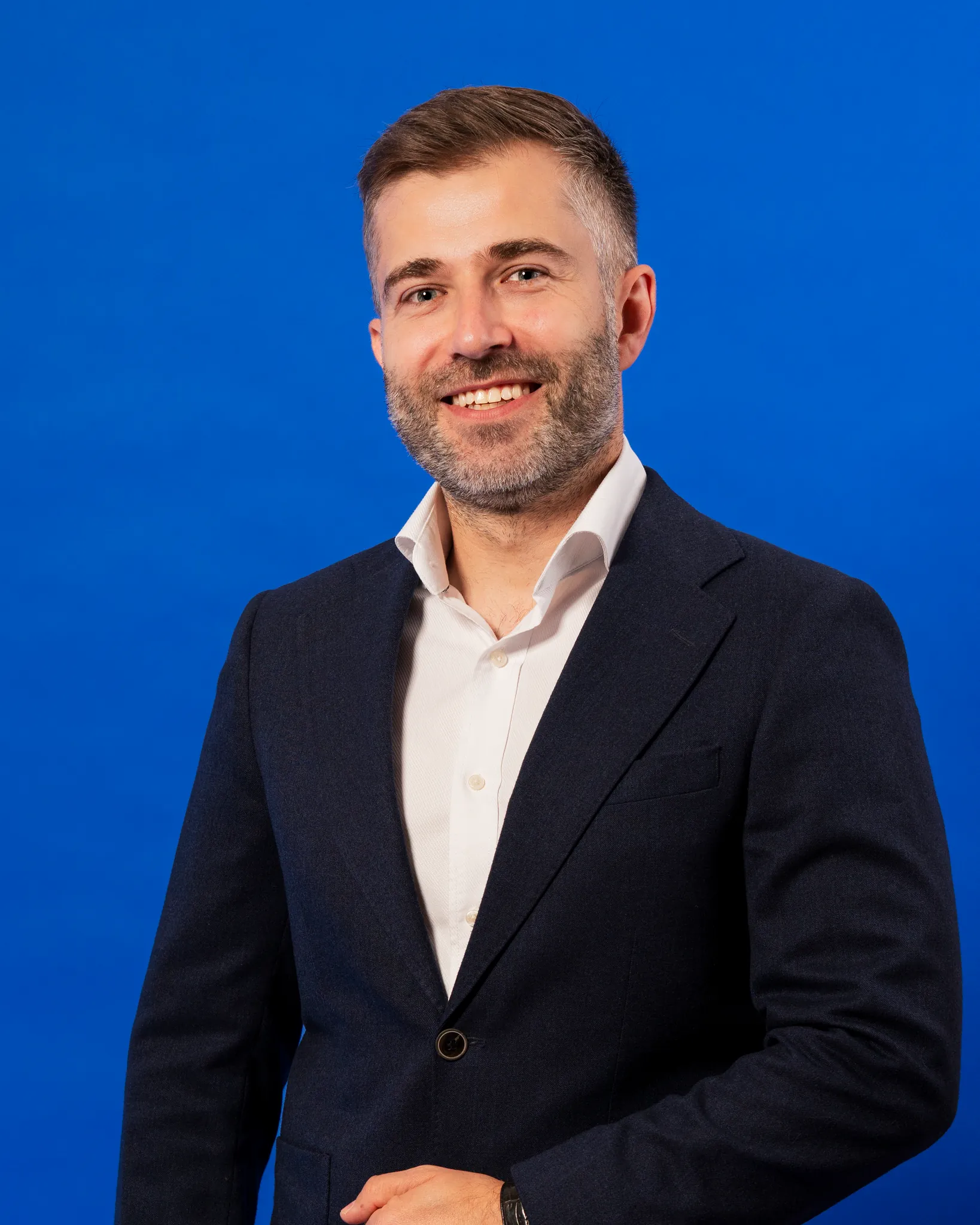
Łukasz Ostoja-Kasprzycki of PoWarszawsku talks Adrian Martinez and Olga Sochanek through the history of office Warsaw: from the pre-war Prudential building and the 1970s Intraco, through Kurtis Plaza (1992), one of the first office buildings designed for open-plan working, to the post-transition boom and the sprawl of Mordor in Służewiec. In his view Służewiec will not lose its offices entirely, but Warsaw's office centre of gravity will keep “jumping”: today it is Rondo Daszyńskiego, tomorrow perhaps Żerań or Ursus.
A conversation with Łukasz Ostoja-Kasprzycki of PoWarszawsku about the history of office Warsaw, Mordor, high-rises and what lies hidden underground. Hosted by Adrian Martinez and Olga Sochanek. (The episode is in Polish.)
Watch the full conversation Brookfield Partners podcast · office Warsaw WatchFrom a Facebook group to walking tours of 1,000 people
Olga SochanekBefore we talk about office Warsaw, tell us a bit more about what you do. You organise walking tours that draw huge crowds, as many as 1,000 people.
Łukasz Ostoja-KasprzyckiPoWarszawsku is more a project than a single thing: it is made up of social media, live walking tours through the streets of Warsaw, and on top of that I host a programme on Polskie Radio (Poland's public radio broadcaster). In truth, I deal with everything to do with Warsaw, above all its history and its present.
Olga SochanekWho comes on these walks? Residents or tourists?
Łukasz Ostoja-KasprzyckiWhat pleases me most is who the group is. They are not tourists. Most are people who have lived in Warsaw all their lives, or for some time, and want to get to know their own district or one they have never visited. The most common case is Praga. The legend of a slightly dangerous Praga is still alive, and people are wary of exploring it on their own, so they come on the walks. We go into every courtyard gateway, we have arranged access, and seeing the place that way is simply different from going alone.
Adrian MartinezWhere does your fascination with Warsaw come from?
Łukasz Ostoja-KasprzyckiAs a teenager walking around the city, I always wondered why a street had that particular name in that particular place. Żurawia Street: presumably cranes (żurawie) once lived there. It turns out not at all: the name comes from the Żurawka river. And another curiosity: spelling Żurawia with a plain “u” is actually a naming error, and it appears on every street sign. Once I started finding these things out, I wanted to share them with someone. I set up a small Facebook group, invited my closest friends and posted photos and stories. Over a dozen or so years it grew to a surprising size.
Prudential, Intraco and Mordor on Domaniewska
Adrian MartinezLet's go back to the beginnings of office Warsaw. What was the first office building?
Łukasz Ostoja-KasprzyckiThe Palace of Culture and Science was built in 1955, but it is more a complex than an office building, combining office, cultural and sports functions. An earlier example is the famous Prudential, today Hotel Warszawa on Plac Powstańców Warszawskich. It was built between the wars and was an insurance company's office building from the outset. An incredible building: it survived a direct shell hit during the Warsaw Uprising because it had a reinforced concrete structure designed by Stefan Bryła. For me it is the icon of pre-war office Warsaw.
Adrian MartinezAnd the 1970s and 1990s?
Łukasz Ostoja-KasprzyckiThe 1970s gave us Intraco 1 in 1975 and Intraco 2 in 1978, and Universal, the blue tower on Plac Bankowy. Back then, Varsovians wondered why such huge buildings were needed and who was going to live in them. They were built for state institutions, not corporations. The real office boom came in the 1990s, after the transition, and gathered most pace at the start of the 21st century, which is exactly what the growth of Mordor shows. After 1989, with trade liberalised and companies invited into Warsaw, large corporations wanted office space of their own.
Adrian MartinezAnd Kurtis Plaza, reportedly one of the first office buildings on this side of the city?
Łukasz Ostoja-KasprzyckiYes, 1992, Mokotów. Very modern for its time: computer-controlled security and fire protection systems were far from standard in 1992. It was also one of the first buildings designed for open-plan working; that is where it all started. I worked there for a few years, so I was sorry to see it demolished. If I could bring one back, it would be Kurtis Plaza, to show future generations what the first office buildings in Warsaw looked like. I will miss Intraco 1 too: I am hearing that it will be demolished after all.
Mordor: past, present and future
Adrian MartinezHow do you see the future of Mordor? Fewer and fewer companies want an office there, and rents are falling.
Łukasz Ostoja-KasprzyckiSłużewiec started out as an industrial area. In the 1950s there were factories there, and the housing estates were built as so-called emergency housing for workers, so they could live close to the plants. It was also home to the first large-panel concrete blocks in Poland. Later, in the 1990s, the area turned into an office district, but once again the life around it was forgotten. Again it became a place where you worked and then fled home after hours. I used to watch the crowds at the tram stops, with trams ferrying people from the metro to Mordor, and I knew it could not last. And it has indeed started to change, partly thanks to activists and the tenants themselves. Now residential buildings are going up there at a fast pace, and a school is being built.
Adrian MartinezWill the offices disappear or stay?
Łukasz Ostoja-KasprzyckiI think some of the offices will stay; I don't believe it will turn into a district with no offices at all. But Warsaw will keep jumping around in office terms. Right now the centre is Rondo Daszyńskiego; later that area may become somewhat saturated too and start turning back into a residential district. The corporate ghosts will find somewhere else, perhaps Żerań, which is changing rapidly right now, perhaps Ursus. It is hard to predict.
Shanghai, or Warsaw after all?
Olga SochanekPoland is one of the fastest-growing office markets in Central and Eastern Europe. How do you assess that growth?
Łukasz Ostoja-KasprzyckiI see both pluses and minuses. The most important thing is not to get carried away. The area around Rondo Daszyńskiego is changing very quickly, and it is easy to put up lots of office buildings while forgetting the city's historic fabric. That is why I like projects that combine history with modernity: Norblin, Browary Warszawskie, Hala Koszyki, Centrum Praskie Koneser. These are places with a story to tell; they have preserved original fragments and they look after their history. When we put up too many towers side by side with no historic fabric at all, we create a second Shanghai, and we build soulless places that die after 5 pm.
Adrian MartinezA provocative question: are we already on the road to Shanghai?
Łukasz Ostoja-KasprzyckiI am not keen on comparing Warsaw with other European cities, because I think today they could be comparing themselves with us: we are setting certain trends and directions. If you look at the Warsaw skyline from one of the bridges, it is not yet a massively built-up city. We have plenty of room for towers, and they still arouse curiosity among Varsovians. When a new viewing terrace opens today, there are crowds. We should do it sensibly, so as not to forget the smaller buildings, but I think we still have a lot of time.
Olga SochanekAnd how do you see the future of office Warsaw in the context of hybrid work?
Łukasz Ostoja-KasprzyckiI listen to friends who work in corporations. They say that going into the office, when they mostly work from home, is a kind of entertainment for them: you can walk into an office tower, look down on Warsaw from above, have a coffee with people. If we went back to the office full time, we would probably get fed up again. But office buildings will not disappear: senior roles and roles that need specific work tools have to be housed in concentrated spaces. And Warsaw is only just getting started when it comes to attracting investors: we are in the top 3 of every business ranking that encourages investment. Now others are imitating us, rather than us chasing others.
To finish: a favourite place in Warsaw
Adrian MartinezOne place in Warsaw: your favourite, the most interesting, somewhere you can go during a lunch break. The Palace of Culture doesn't count.
Łukasz Ostoja-KasprzyckiI love places that carry history with them: modern and revitalised, but where you can still feel the spirit of the past. I recommend Park Dreszera, the former Mokotów Park on Odyńca Street in Stary Mokotów. Today it is a fenced park with a fountain, a restaurant and a playground; you can come with a blanket and your dog. But it was once one of the largest makeshift cemeteries in Warsaw. In the 1950s thousands, perhaps tens of thousands, of bodies were exhumed there. It was also a drop zone for relief supplies during the occupation. And, incredibly, the layout of today's paths and lawns follows the layout of the graves from that time. Once you know that history, you look at the place a little differently. That is what I would encourage: wherever you are, even in an office building, open Wikipedia and check what an incredible place you are in. Warsaw has history on every square metre.
5 key takeaways from the conversation
- PoWarszawsku is a project about Warsaw: social media, live walking tours (up to 1,000 people) and a programme on Polskie Radio. Its audience is mainly residents who want to get to know their own city better.
- The icon of pre-war office Warsaw is the Prudential building (reinforced concrete by Stefan Bryła; it survived shelling). The 1970s brought Intraco and Universal, while the real office boom came after 1989 and in the early 21st century.
- Kurtis Plaza (1992, Mokotów) was one of the first office buildings designed for open-plan working and very modern for its time. It no longer exists.
- Mordor (Służewiec) repeated the mistake of a “place only for work”. Today it is gaining housing and a school; some offices will stay, but Warsaw's offices keep “jumping”: today to Rondo Daszyńskiego, in future perhaps to Żerań or Ursus.
- The biggest risk is a “second Shanghai”: a forest of towers with no historic fabric creates spaces that “die after 5 pm”. It is better to combine history with modernity (Norblin, Browary, Koszyki, Koneser). Warsaw still has plenty of room and is setting trends.
Łukasz Ostoja-Kasprzycki runs PoWarszawsku on Instagram and Facebook and hosts a programme on Polskie Radio. He organises walking tours of Warsaw for groups of up to 1,000 people. Adrian Martinez and Olga Sochanek host the Brookfield Partners podcast about work and office space.