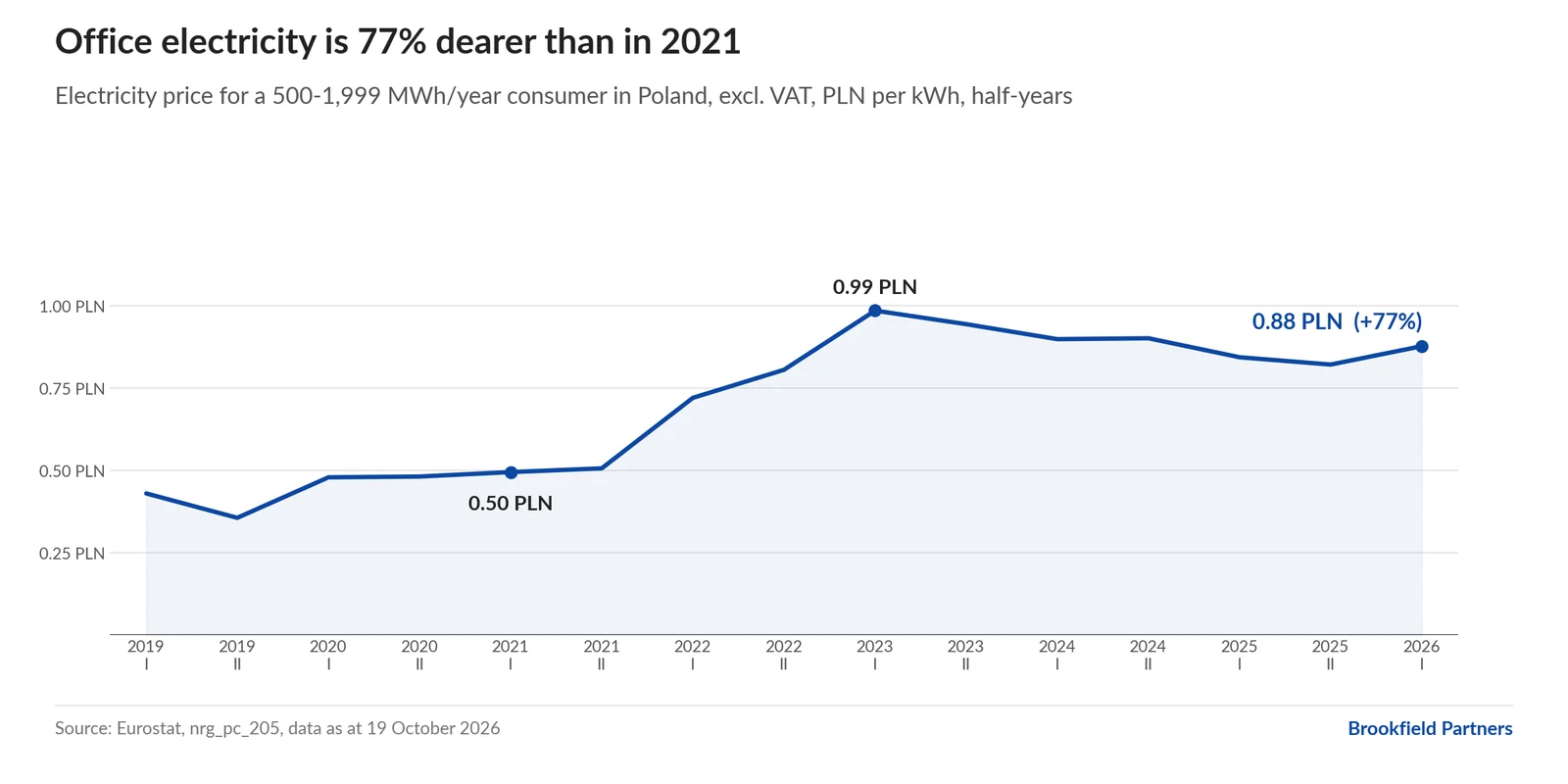

An office building in Poland now pays PLN 0.88 per kWh net for electricity, 77% more than in the first half of 2021 and 15% more than the EU average. After two years of declines the price is rising again: in the first half of 2026 it was 7% higher than six months earlier, and the exchange contract for 2027 delivery rose by 28% between March and September. Tenants never see the electricity bill, but they pay it through the service charge. Budgets for 2027 are being prepared right now, and this is the moment to ask the property manager a few questions.
Energy is the largest item in the service charge budget over which the tenant has the least control. The tenant does not choose the supplier, does not negotiate the rate and does not decide when the building buys power for the coming year. It receives a ready invoice, apportioned by square metre. That is why it pays to know what is happening to the price before the new budget arrives in December.
What an office building pays for electricity
Every six months Eurostat publishes electricity prices for non-household consumers, broken down by consumption band. A typical office building falls into the band from 500 to 2,000 MWh a year. Below is the price for that band in Poland, excluding VAT but including distribution and all the levies a company cannot recover: excise duty, the capacity fee, the renewables fee and the cogeneration fee.
| Period | Price, PLN per kWh net | Change vs H1 2021 |
|---|---|---|
| H1 2021 | 0.50 | |
| H1 2022 | 0.72 | +46% |
| H1 2023 | 0.99 | +99% |
| H1 2024 | 0.90 | +82% |
| H1 2025 | 0.84 | +70% |
| H2 2025 | 0.82 | +66% |
| H1 2026 | 0.88 | +77% |
Source: Eurostat, dataset nrg_pc_205, band 500-1,999 MWh, price excluding VAT, as at 19 October 2026.
The peak came in the first half of 2023, when the price almost doubled compared with 2021. It then fell for two years, but never returned to its starting point. It settled two thirds higher. And in the first half of 2026 it turned upwards again.
For a building consuming 1,000 MWh a year, the middle of that band, the difference between the 2021 price and today's is around PLN 380,000 a year. All of it goes into the service charge.
Why Poland is now dearer than Germany
In euro terms, a Polish office building pays EUR 0.207 per kWh today. The EU average is EUR 0.180, Czechia is at 0.167 and Germany at 0.206. As recently as 2021, Poland was 15% below the EU average. Today it is 15% above, on a par with Germany.
Two reasons. The first is generation: in 2025, 52.7% of Poland's electricity came from coal, so the cost of CO₂ allowances feeds into the price more heavily than in countries with more nuclear and renewables. The second is levies and taxes, whose share of the price paid by companies is the highest in the EU: 36% against an average of 18%. The fastest growing of these is the capacity fee. It was PLN 0.0762 per kWh in 2021, PLN 0.1412 in 2025 and PLN 0.2194 from January 2026. Almost threefold in five years. Companies pay it on energy drawn on working days between 7:00 and 22:00, exactly when an office is running.

What the data show for 2027
Building managers usually buy energy for the following year in the autumn, through forward contracts on the Polish Power Exchange (TGE). The contract for 2027 delivery cost an average of PLN 433 per MWh in March 2026 and PLN 556 in September. That is a 28% increase in six months. The spot price rose even faster, from PLN 465 to PLN 667 per MWh. The driver is the rise in gas and carbon prices in Europe, the same one that pushed euro area inflation up to 3.8% in September.
The wholesale price is roughly half of an office building's bill. The rest is distribution and regulated levies. The Energy Regulatory Office (URE) announces capacity fee rates for the following year in the autumn and distribution tariffs in December. In recent years both have gone up.
Further ahead there are more unknowns than data. From 2028 the EU's ETS2 scheme will put a carbon price on fuels used to heat buildings. For office buildings served by district heating fired by coal or gas, that means a higher price of heat. On the other hand, the growing share of wind, solar and storage in Poland's mix should push the wholesale price down in the coming years, especially during daytime hours. Which effect prevails in any given year, nobody knows today. For a tenant the conclusion is simple: the cost of energy in an office building will remain volatile, and the lease should allow for it. We describe the other side of that risk, rent indexation to inflation, in our article on HICP rent indexation.
How energy gets into the service charge
A tenant pays for electricity in two places. The first is its own meter, for energy used in the leased space: computers, lighting, the server room, the coffee machine. The landlord re-invoices this item according to the meter reading and the price it obtained from the supplier.
The second is the service charge, which contains the energy of the common parts: lifts, ventilation and air conditioning, lighting in lobbies and the car park, pumps, security systems. In a modern office building this consumption is often comparable to all the tenants' meters combined, and in buildings with a high cooling load it is larger. The cost is apportioned to tenants by floor area, charged monthly in advance and reconciled after the end of the year. We show the level of those advances in Warsaw, Wrocław and Kraków in our article on office service charges.
Three things follow that are worth checking in the lease and the budget.
What price the landlord pays for electricity. A building that contracted its energy for 2026 in the autumn of 2025 paid much less than one buying on the spot market. Managers are not obliged to disclose the terms of their supply contract, but a tenant is entitled to ask what unit price was assumed in the budget and whether it is contracted or forecast.
Whether there is a margin on the re-invoice. The lease should state explicitly that energy used by the tenant is re-invoiced at cost, with no mark-up. Some leases contain wording that allows a "handling cost" to be added or the supplier's tariff price to be applied instead of the building's contract price.
How much energy the common parts use and whether anyone controls it. The 2027 budget should show not only the amount but also consumption in MWh and the unit price. If consumption rises year on year in a building whose occupancy has not increased, the question is why. Ventilation running at weekends, cooling of empty floors and car park lighting on around the clock are the typical places where a building wastes power at tenants' expense.
What to ask before accepting the 2027 budget
Most tenants receive the service charge budget in December and accept it in silence. Yet this is the one moment in the year when they can influence this item. Five questions worth putting to the property manager:
- What energy price in PLN per MWh was assumed in the budget, and does it come from a signed contract or a forecast?
- How many MWh did the common parts use in 2025, how many does the 2026 budget assume and how many the 2027 one?
- Does the building have an energy audit or an energy management system, and what savings measures are planned?
- Does the budget contain costs that should not be charged to tenants, for example energy used by vacant space or by the owner's commercial installations?
- How will the difference be settled if the actual price turns out lower than budgeted?
On a new lease or a renewal it is worth going a step further: writing in a cap on the annual increase of landlord-controlled charges, a right to inspect utility invoices and the principle of re-invoicing at cost. We describe the provisions that make such clauses work in our article on ten costs to exclude from the service charge.
Energy will not return to 2021 prices. A tenant cannot influence the exchange or the capacity fee. What it can do is make sure it pays for the power the building actually used, at the price the building actually paid.