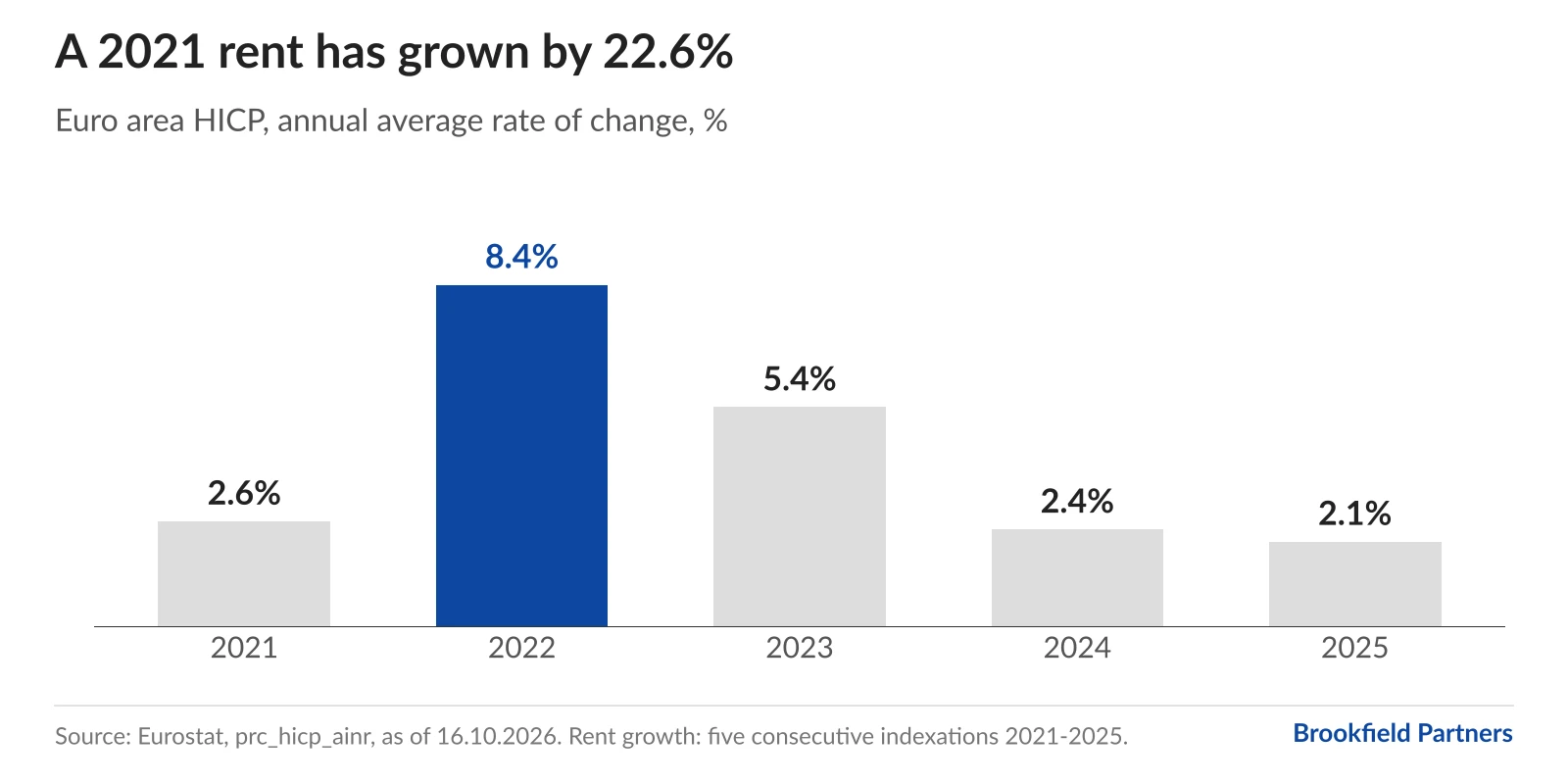

Office rent in Poland is almost always denominated in euro and raised once a year by the euro area HICP. Indexation only ever works upwards. Over four years of high inflation, the rent in a lease signed in 2021 has grown by more than 22%, and in September 2026 euro area inflation accelerated again to 3.8%. A lease can include a cap on annual increases, a deferred first indexation, a precise definition of the index and a provision for deflation.
Indexation is the least discussed clause in an office lease, yet over ten years it can cost more than all the incentives negotiated at the outset put together. Most tenants check the rent, the rent-free period and the fit-out budget, and accept the indexation clause in the form proposed by the landlord. Below I explain how the mechanism works, what it has cost in recent years and which of its elements can be changed.
How rent indexation works in an office lease
In office leases in Poland, rent is denominated in euro and settled in zloty at the National Bank of Poland rate. Once a year, usually on 1 January, the rent is increased by the annual inflation rate. For euro rents this is the HICP, the harmonised index of consumer prices published by Eurostat for the euro area. For zloty rents, the consumer price index published by Statistics Poland (GUS) is used.
A typical clause reads roughly as follows: the rent is indexed annually by the HICP for the previous calendar year, and if the index is negative the rent remains unchanged. Three things follow from that one sentence, and they are worth understanding before you sign.
First, indexation works in one direction only. In deflation, the rent does not fall. Second, each indexation is applied to the rent already indexed, so the increases compound. Third, the index measures consumer prices in the euro area, not conditions in the office market in Warsaw or Kraków. The rent rises regardless of whether vacancy in your building has gone up.
What indexation has cost in recent years
For a decade before the pandemic, euro area inflation hovered around 1-2% a year and indexation was treated as a formality. That ended in 2022.
| Year | Euro area HICP, annual average |
|---|---|
| 2021 | 2.6% |
| 2022 | 8.4% |
| 2023 | 5.4% |
| 2024 | 2.4% |
| 2025 | 2.1% |
Source: Eurostat, dataset prc_hicp_ainr.
For a tenant who signed in 2021, that means five indexations. A rent of EUR 20.00 per sqm in the lease has risen to around EUR 24.50 per sqm in 2026, an increase of 22.6%. For an office of 1,000 sqm that is an extra EUR 4,500 a month and EUR 54,000 a year compared with the starting rent. From the mechanism alone, with no change to the terms of the lease.
Headline rents for new tenants have not risen at that pace. That is why companies that signed before 2022 often pay more today than their new neighbours in the same building. We described this mechanism in more detail in our article on why loyal tenants pay more than new ones.
What the data show for 2026
After two calm years, euro area inflation is rising again. In September 2026 the annual HICP rate was 3.8%, up from 3.2% in August and 2.2% a year earlier. The main driver is energy, which in September was 18.9% more expensive than a year before. Poland's HICP for September was 4.0%.
If the readings for the last quarter stay at a similar level, the indexation on 1 January 2027 will be the highest since 2023. For a tenant paying EUR 24.50 per sqm on 1,000 sqm, every percentage point of indexation is worth around EUR 2,900 a year.
The exact amount depends on how the lease defines the index. Some leases refer to the annual average, others to the December-to-December change, others still to the latest available reading on the indexation date. In a year when inflation accelerates in the second half, the difference between these definitions can exceed a percentage point.
What can be negotiated
The indexation clause is as negotiable as the rent or the rent-free period. In practice we see five solutions.
A cap on the annual increase. A provision that indexation will not exceed a set level, most often 3-4% a year. In 2022-2023 a 3% cap would have reduced the rent increase by more than 7 percentage points. For a 2021 lease, the difference between uncapped indexation and a 3% cap is around EUR 1.75 per sqm a month in 2026, which on 1,000 sqm is about EUR 21,000 a year. Landlords agree to a cap more often than you might expect, especially on leases of seven years or more, because it also protects their income forecasts. Sometimes they ask for a floor in return, for example a minimum indexation of 1-2%. That package needs to be calculated: at low inflation, a floor costs the tenant more than the cap saves.
Deferring the first indexation. If the lease starts in October and indexation takes place on 1 January, the tenant pays a higher rent after just three months. The standard solution is a provision that the first indexation takes place no earlier than 12 months after the lease starts, or only in the second full calendar year.
A precise definition of the index. The lease should specify which index applies (HICP for the euro area, not for the whole EU, as the values differ), for which period (annual average or December to December), as of which publication date, and what happens if Eurostat changes its methodology or stops publishing the index. In February 2026 Eurostat introduced a new classification and changed the reference year to 2025 = 100. Leases that refer to a specific index number rather than the annual rate of change need an amendment in such cases.
Symmetry. A provision that when the index is negative, the rent falls accordingly. Landlords rarely agree to it, but the proposal itself can be a good starting point for a conversation about a cap.
Indexation and effective rent. When comparing offers from several buildings, the rent should be calculated over the whole lease term including indexation, not just the first-year rate. An offer with a lower headline rent but no cap can be more expensive after five years than an offer with a higher rent and a 3% cap. The same applies to service charges, which have their own escalation mechanisms.
What to check in your current lease
If your lease has been running for a few years, there are four things worth checking before the next indexation.
- How much cumulative indexation has added to the rent since signing, and how that compares with the rents offered to new tenants in the building today.
- Whether the landlord calculates the indexation in line with the definition in the lease. It happens that a different reference period, or the EU index instead of the euro area index, is applied, and the difference to the tenant's disadvantage grows year by year.
- How long is left on the lease. If it is less than 24 months, the conversation about indexation should be part of renegotiating the whole package, not a separate topic.
- Whether the lease has a cap at all. If not, introducing one on renewal is one of the cheaper concessions you can ask a landlord for.
Indexation is neither a necessary evil nor a formality. It is a clause that transfers the entire inflation risk to the tenant for the whole lease term. That risk can be limited, but only before you sign.